All the trust of SAP B1. None of the friction.
ReStore doesn't replace your ERP. It wraps it. The same SAP Business One ledger underneath, with screens people actually want to use on top, and an API connection that lifts the limit on how many of them can work at once.
Business One
You've suffered enough.
Your first year of ReStore is on us.
Move from KStore to ReStore and pay nothing for the first twelve months. A far bigger toolbox, screens your people will actually use, and a whole year to prove it. If it isn't the better fit, you walk away. Risk free.
- $0 subscription for the first year
- Walk away any time, no penalty
- For current KStore customers
SAP B1 is a great ledger. It is a demanding day job.
The data model is sound and the accounting is right. But the person taking an order at a counter, the driver cashing up at the depot and the picker in the aisle all meet the same dense, generic ERP forms. So they don't use it. Work goes to paper and WhatsApp, and someone re-types it later.
A simple sale walks through a module tree, half a dozen tabs and fields nobody in that role needs. Training takes weeks and it never quite sticks.
Every extra pair of hands means another named seat. So access gets rationed, and the people closest to the work are the ones locked out of the system.
Rates that move week to week, bank files nothing can read, a base admin that has to be USD while the till takes SRD. Standard ERP has no answer for it.
A shell, not a replacement.
ReStore sits on top of SAP Business One and talks to it over the API. Nothing is re-implemented, nothing is mirrored into a second database, nothing gets out of sync. What you gain is a layer where each role gets exactly the screen its job needs.
Role-shaped apps: mobile sales, POS, picking, purchasing, cash-up, finance reporting, schedulers.
Every action posts through SAP's own API, validated by SAP rather than around it.
Your ledger, master data, stock and documents. Untouched, standard, auditable.
Thirteen modules. One system underneath.
Each one exists because a real customer hit a real wall. Tap a card for its add-ons.
The apps your people carry.
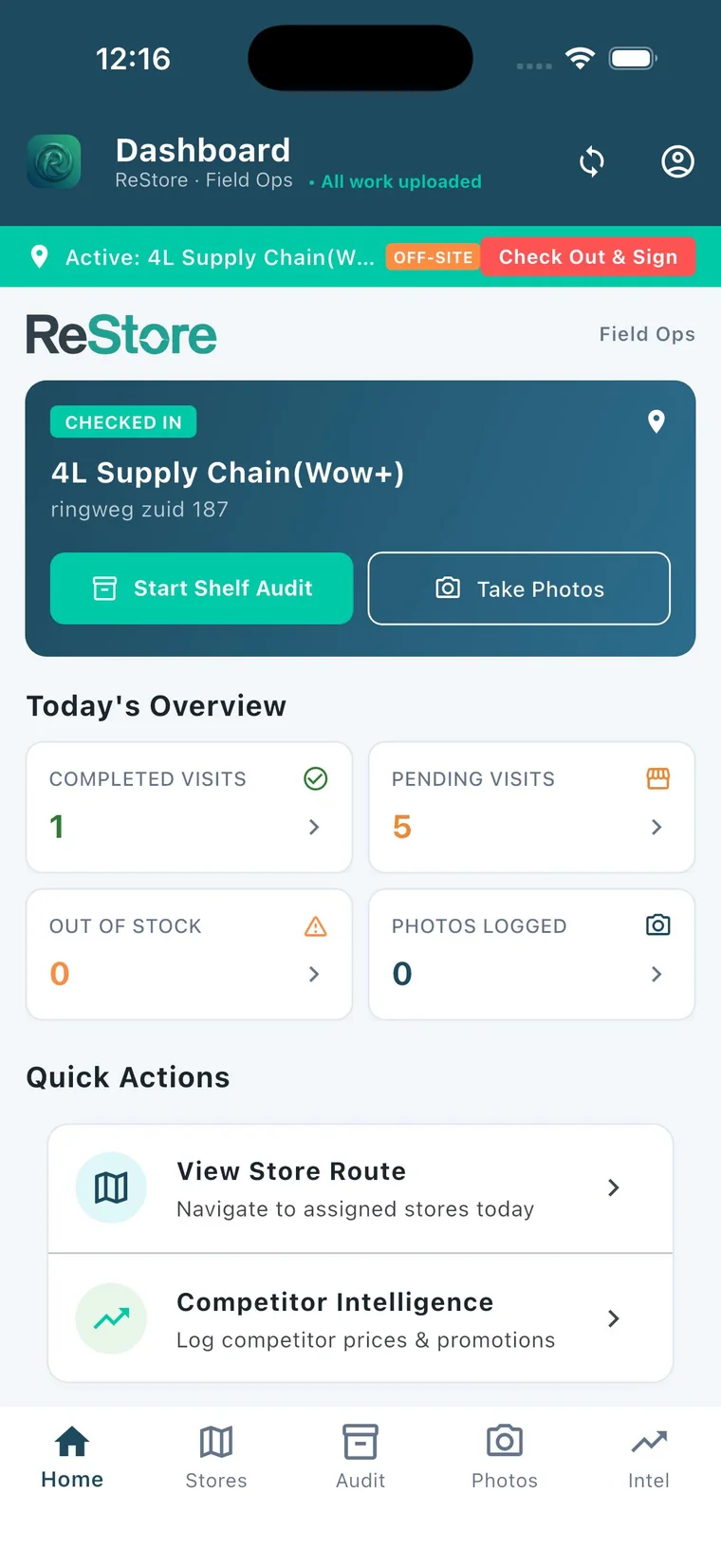
Check in at the store, run a shelf audit, log out-of-stocks and photos, then check out and sign. Work uploads as it happens.
Log competitor prices and promotions. When sales drop, field requests go out automatically and AI evaluates whether pricing is the cause.
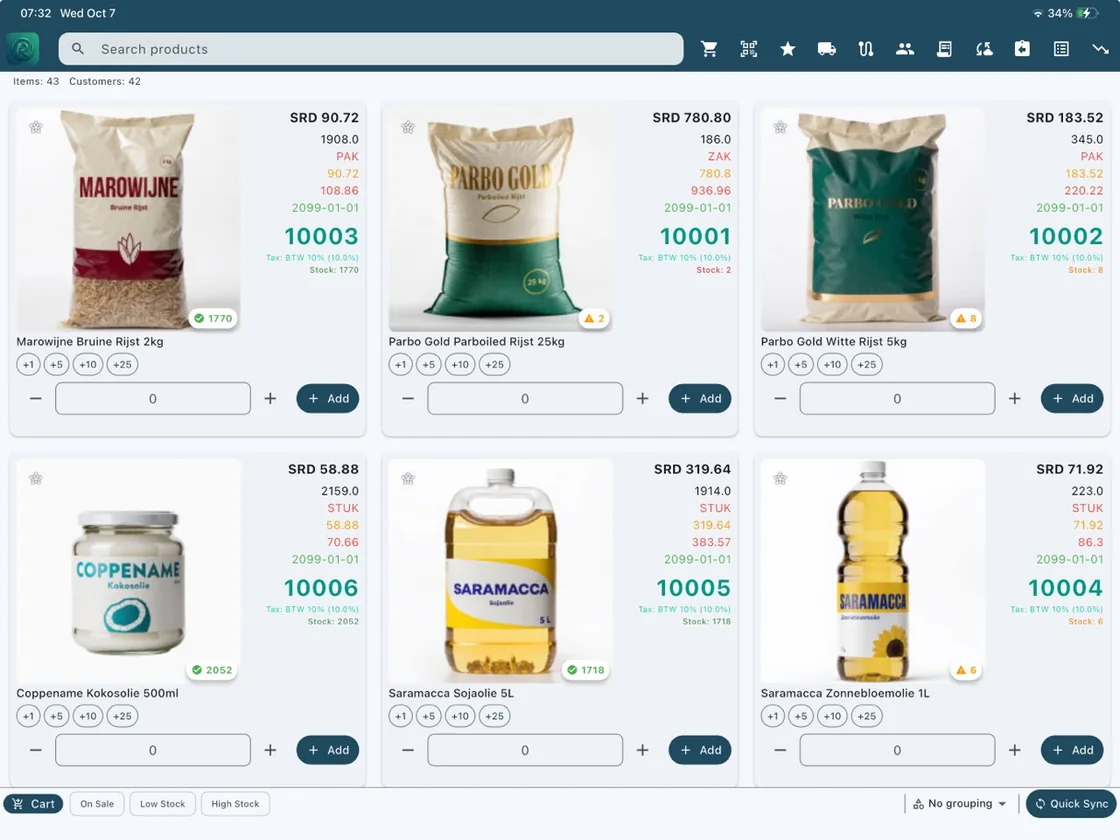
Reps order from a product grid with live stock, SRD prices and quick quantity buttons, then sync straight into SAP.
See what your reps are doing in the field.
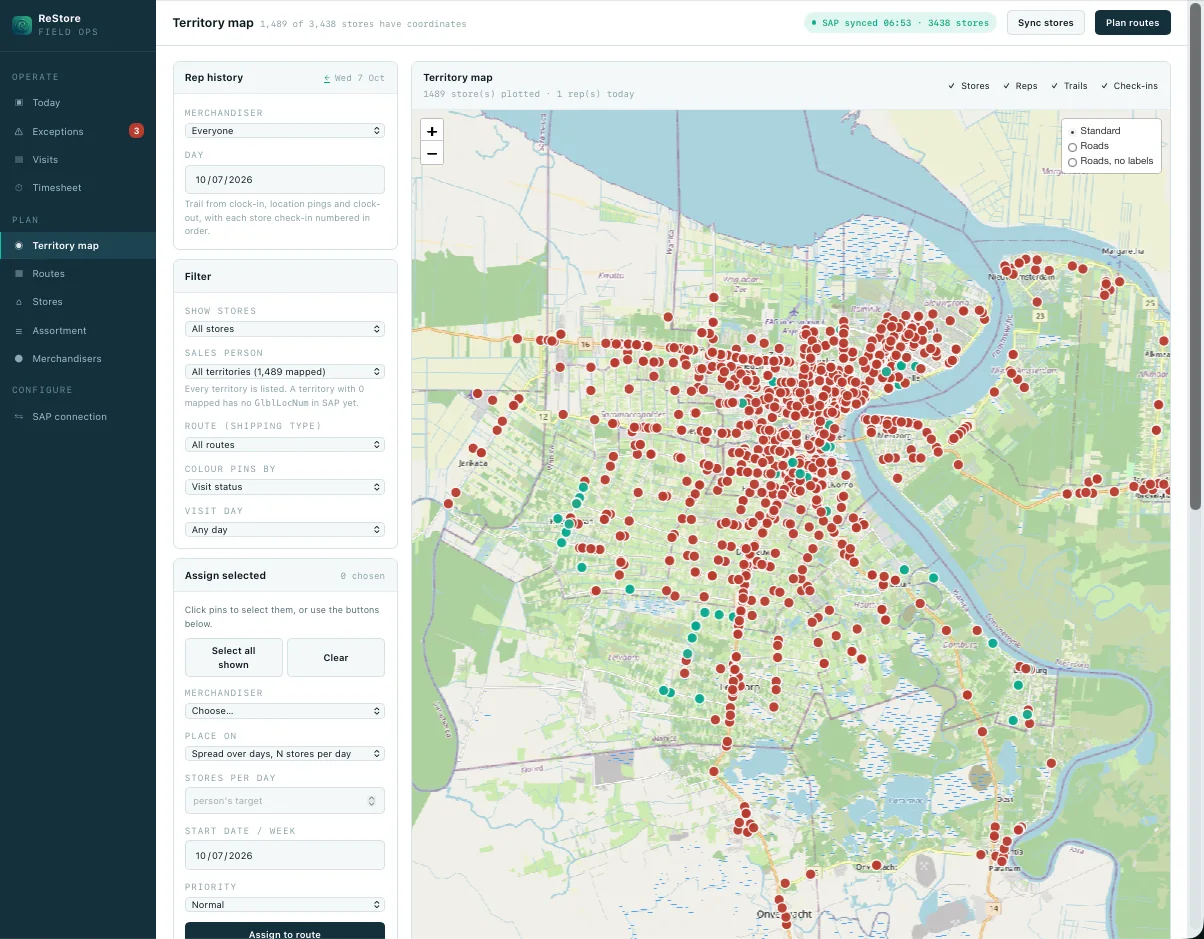
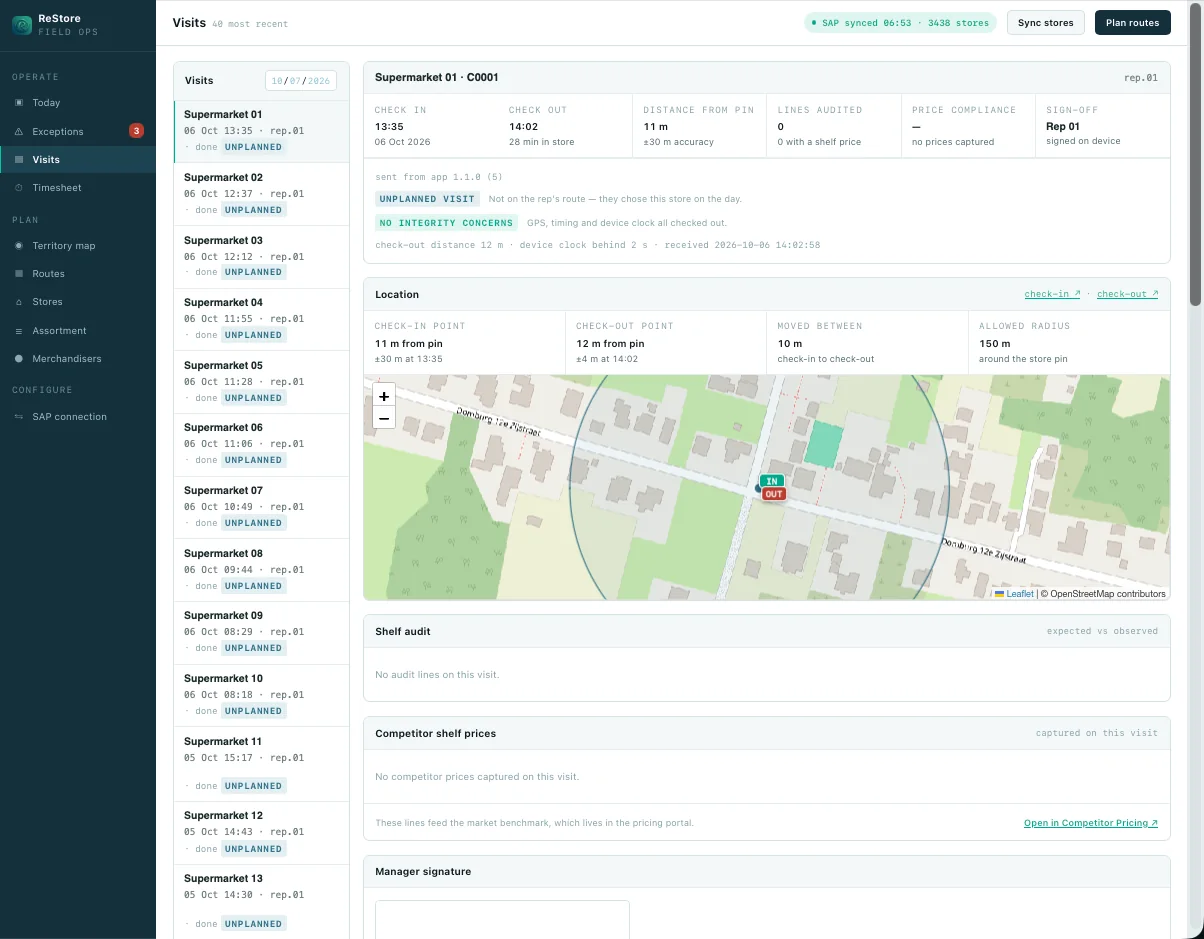
The web interface behind the Merchandisers app. Follow every rep, every visit and every store from the office.
No SAP? ReStore runs on its own.
ReStore Standalone is built for supermarkets, general stores and restaurants. The same till, stock and purchasing tools, without an ERP underneath.
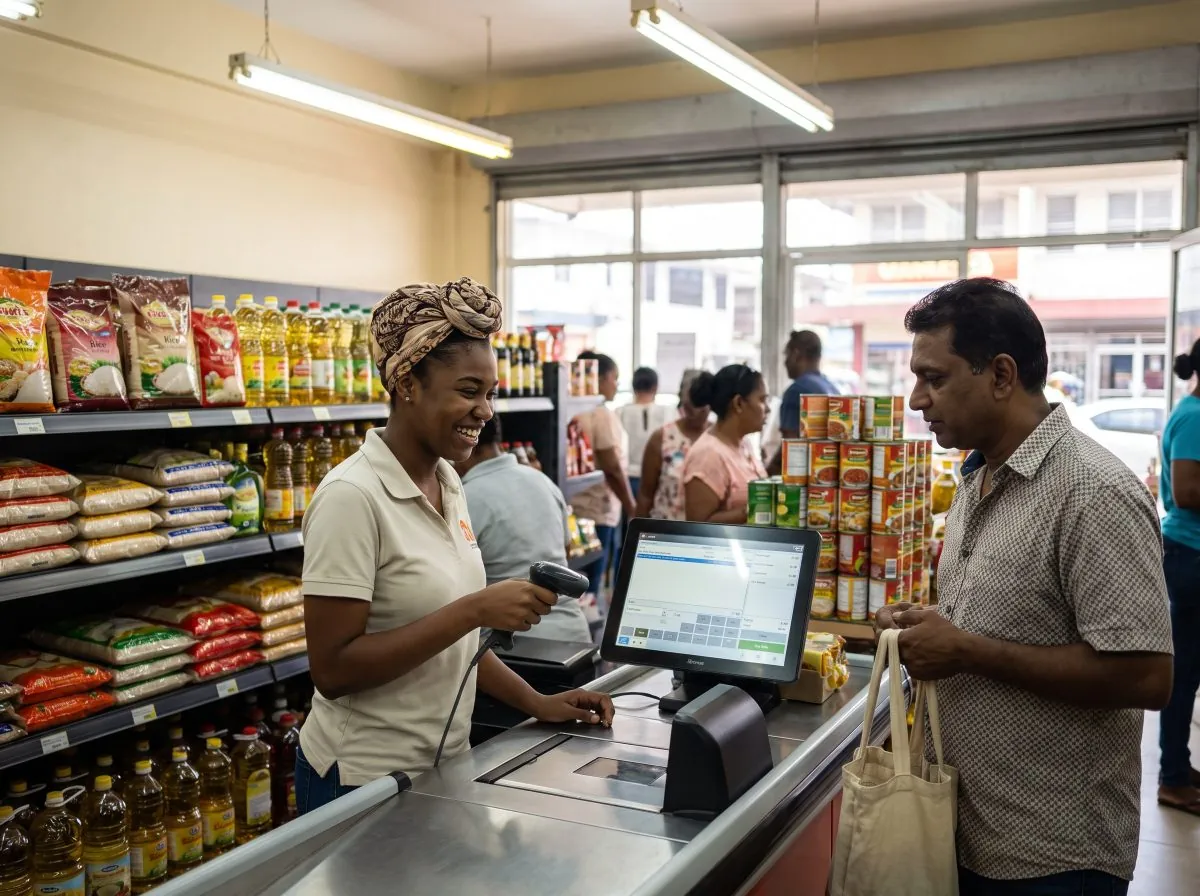
Multi-lane POS in SRD and USD, stock control and receiving. Count and receive stock with Zebra handhelds.
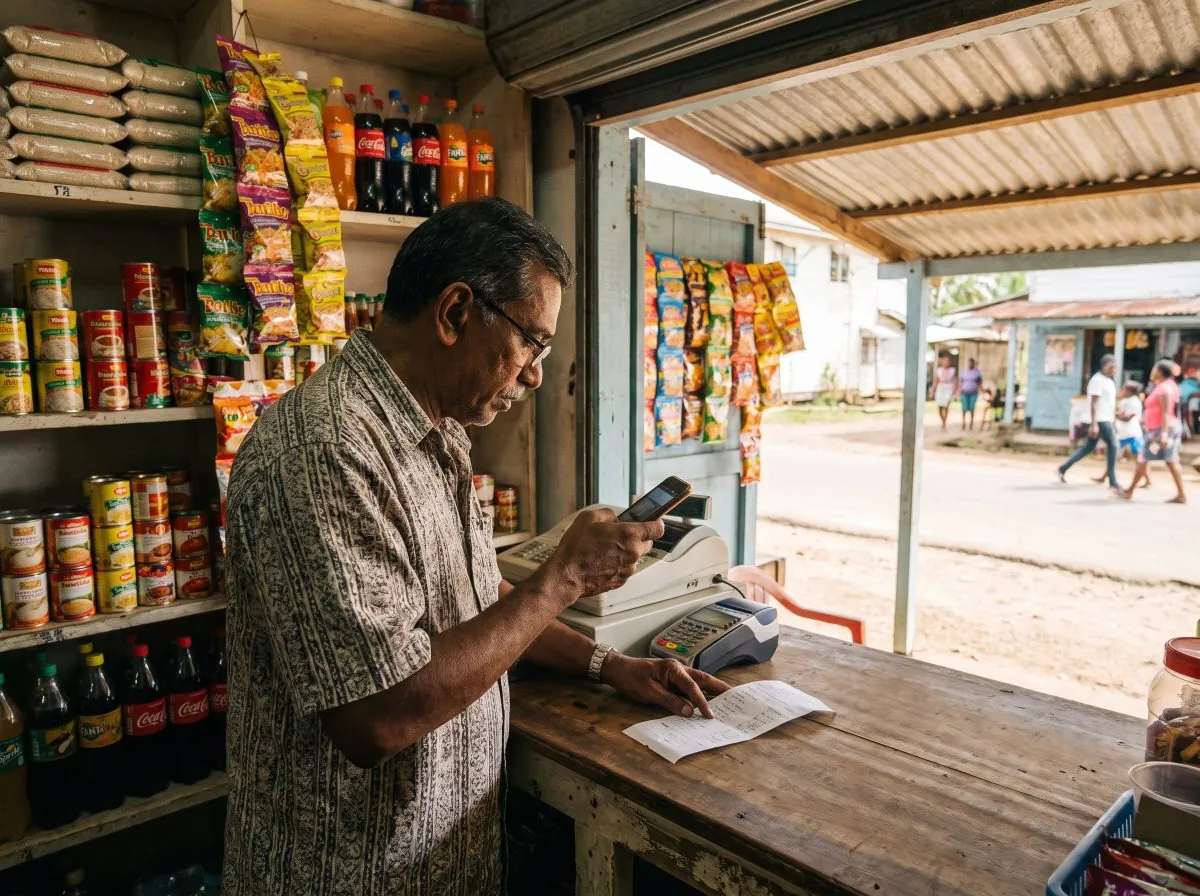
One till, stock that keeps up, and purchase receipts read by AI so buying is booked in minutes.

Take orders at the table on tablets and settle at the till, in either currency.
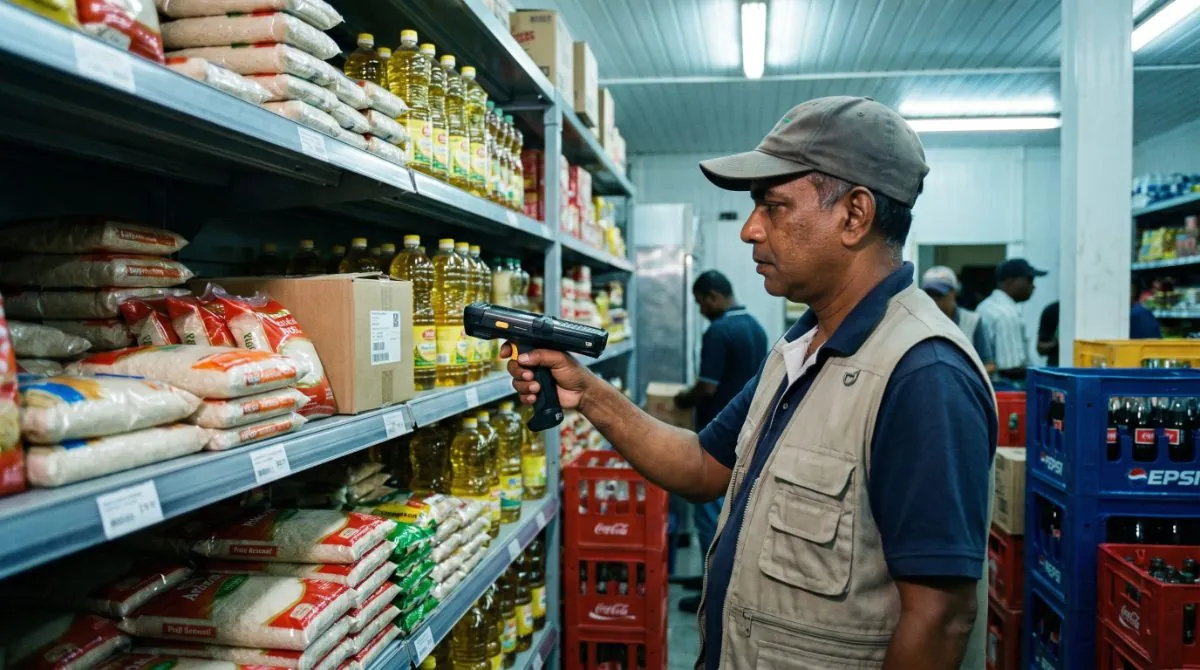
Connect Zebra mobile computers to count stock on the shelf and receive deliveries at the door.
Waiters take orders on tablets at the table. Orders go straight to the till.
Photograph or upload a supplier receipt. AI reads it and proposes the purchase for quicker processing.
Web development, wired straight into SAP.
Not every requirement fits a module. When yours doesn't, ReStore builds the web side too and connects it to the same SAP Business One company, over the same API. The site never becomes a separate island that somebody has to reconcile later.
Retail interface, webshop wired to SAP
Customer-specific pricing, credit status, account portal
Webshops and B2B ordering portals that read live stock, customer-specific pricing and credit status straight from SAP.
Customer self-service: order history, open invoices and delivery status, without a phone call to your office.
Custom web applications for the process that is genuinely yours, built on the same connection as the rest of the range.
Orders placed online arrive in SAP as real documents, not as an email someone re-types the next morning.
For the love of automation!
Cheaper because of where the cost usually hides.
The licence line on the quote is rarely what makes an ERP expensive. It's the seats you buy for people who only need to do one thing, the custom development for gaps the product never covered, and the hours spent re-keying what a machine should have read. It's also the costly hourly consultancy rates paid to the very people that profit from longer implementations, limitations and continuous consultancy to solve issues that should not be there.
Because ReStore works over the API, occasional users such as pickers, drivers, cashiers and viewers get into the process without each consuming a full SAP licence. Access stops being something you ration.
Landed cost, multi-currency POS, Caribbean bank imports, truck cash-up, digital picking. The things that normally become a custom development project are already in the range.
Statements import and match themselves. Receipts get read and proposed. Reconciliations and reports run overnight. That's payroll time returned to the business every single month.
| Task | SAP B1 ON ITS OWN | SAP B1 + RESTORE |
|---|---|---|
| Getting an occasional user into the process | Another named licence | API access, no extra seat |
| Time to train a counter salesperson | Weeks on generic forms | One screen, one job |
| Selling in SRD on a USD base admin | Workarounds & drift | Native to the POS |
| Local bank statement into the ledger | Manual entry | Imported & auto-matched |
| Booking a stack of supplier receipts | Line by line | AI reads and proposes |
| Filling a functional gap | Custom dev project | Already in the range |
| Support & upgrade path | Add-on stack, many vendors | One range, standard core |
Published, per company, per month.
No per-seat licence and no user ceiling. Prices are in USD and cover the whole company, however many people use it. If you are a small business of five users or fewer, you pay half.
Made in Suriname, for currencies that move.
ReStore wasn't designed in a market where the rate holds still and every bank exports a clean file. It was built to survive one where neither is true, which is exactly why it holds up everywhere else.
Hold the admin in USD so item cost stays stable and reliable, and still sell, take payment and report in the local currency at the counter.
Lazybanks reads the statement formats regional banks actually produce, pushes them straight into SAP, and matches payments against open invoices on the way in.
Loadmaster plans and picks the load. ReconX takes the money back off the truck, scanning in extra invoices and credit notes as the driver hands them over.

Keep SAP. Lose the friction.
See your own processes running through the shell. A walkthrough on your data, not a canned demo.